
one evening at the ranchería wayuu
moral relativism over a goat stew

The goats haven’t returned yet, but that doesn’t stop the ranchería from buzzing with life this hot late afternoon. Dinner is being prepared in the kitchen, kids are running around laughing, and a couple of adults are diligently preparing to receive a group of visitors—me, my fiancé, and three other solo travelers who joined us on this trip into Colombia’s northernmost desert.
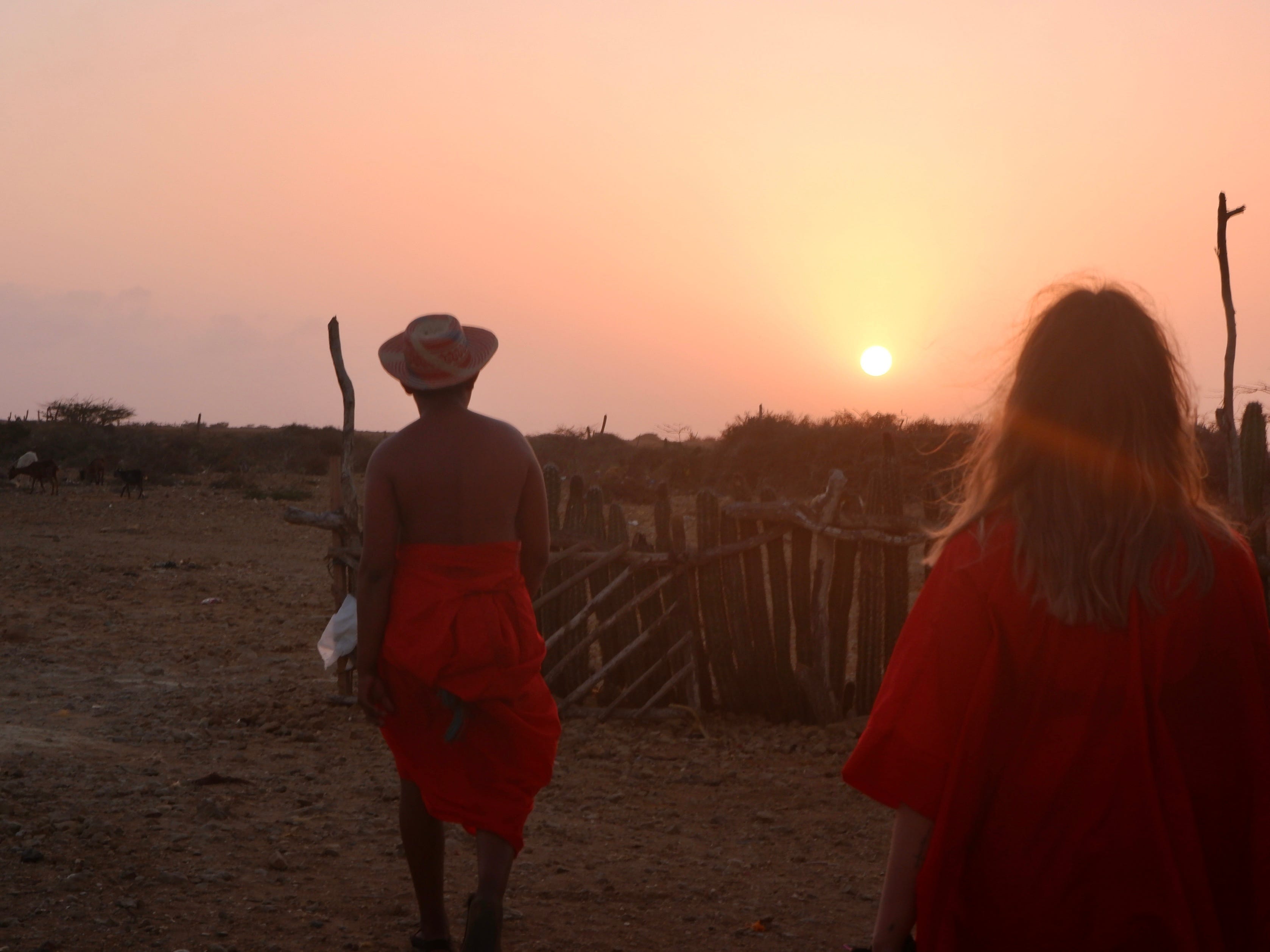
It’s the third day of our tour through the remote landscapes of La Guajira, and this evening is dedicated to meeting the indigenous Wayuu people and spending some time with their clan.
We’re greeted by our host, a cheerful young woman named Ana, whose warm smile immediately puts us at ease. She and her brother will be facilitating our tarde de ranchería and teaching us about the Wayuu lifestyle and culture before we share a typical dinner of goat stew.
One of the girls from our group has a good camera and wastes no time snapping pictures of everything around us, especially the playing children. I ask our host if it’s OK to take photos, and she assures me that it’s fine. The kids are cute as hell and love the attention, but I still decide against sticking a camera in their faces, since they definitely had no say in this whole tourism thing.
Ranchería is the name for a Wayuu settlement. Usually one ranchería is only inhabited by people from the same family or clan.
After a brief tour of the premises, we gather in the communal space to officially start the program. Ana first shows us a collection of colorful handcrafted bags and begins to tell us their story.
“It all starts with our men, who got jobs at the turtle conservation project…”
We’re confused as to what men and turtles have to do with bags, but the point of her tangent is that as the Wayuus were forced to transition from their traditional herding lifestyle to participating in broader Colombian society, men secured employment and the women, too, started looking for ways to make money. Hence, they began selling their traditional crafts. I’m unsure of why they have to credit men for it, but that seems to be the Wayuu way in many aspects, as we soon find out.
The mochila Wayuu is the most exported Colombian handicraft and has, in many ways, become synonymous with the country. Many Colombians have at least one at home.
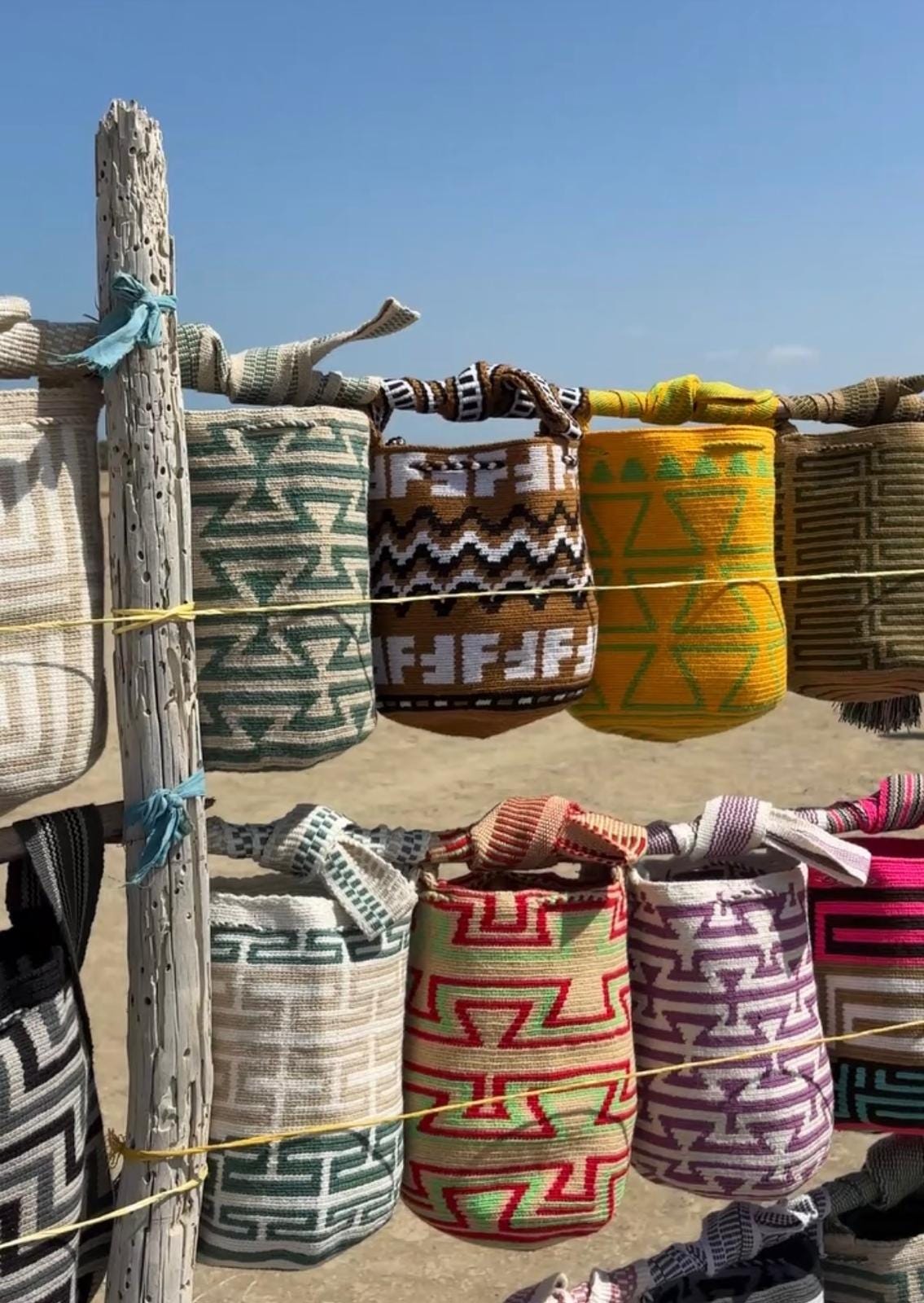
We look at the selection, and while there’s no pressure to buy, we feel like we should support the hustle. Since I already have a mochila Wayuu, I opt for a pink bottle holder, and David gets a few miniature bags as gifts for his family. It’s only later when we learn that while women weave the bags, the smaller items are actually made by little girls. Now I don’t know whether it was women’s empowerment or child exploitation I just supported, but the deal is already done.
As the visit continues, Ana paints our faces with red ornaments and we all get dressed in traditional Wayuu attire. To everyone’s amusement, David “wins” a rather revealing outfit that looks like a miniskirt accompanied by a shirt with the clan’s name and mascot on the back. Girls are given red mantas, traditional women’s robes ideal for the desert heat.


While many Wayuu wear Western clothes nowadays, they still use their traditional attire for ceremonies and special occasions. Schools also have designated Wayuu clothing days at least once a week, and some workplaces even offer Wayuu-style uniforms.
Once we’re looking the part, we sit around a fire, and Ana gets to storytelling. It’s time to learn about the Wayuu history, customs, and traditions.
Unlike most Western societies, Wayuu society is matrilineal, meaning that women carry on their family, or clan, name. For that reason, women are held in high regard.
That, however, doesn’t mean that they’re emancipated.
As tradition dictates, when a Wayuu girl becomes a woman (read: gets her first period), she’s supposed to seek out her maternal grandmother, who explains to her what’s happening and helps her navigate womanhood locks her in a barn for three years. Yes, really.
During their time locked up, young Wayuu women aren’t allowed to see anyone besides their grandma, get fed a very strict diet of chicha and vegetables (apparently so that they’re used to hunger and trained to feed their children first should they face scarcity), and have to complete a set amount of weaving projects that would become their dowry, including chinchorros (hammocks), mantas, and, of course, bags.
This custom, known as encierro (literally “enclosure”), has been part of the Wayuu culture for centuries, and its rules were only relaxed once the tribe entered the school system. Suddenly, it became unacceptable for girls to miss school for three whole years, and tradition had to make way for education. Nowadays, the encierro is still practiced, but it “only” lasts anywhere from one week to one month.
School is a topic that pops up frequently throughout our conversation with the brother-sister duo. When they were growing up, their closest school was in Nazareth, about a four-hour drive by dirt road, so they had to attend a boarding school. But even getting an education comes with extra sidequests for the Wayuu. The spots at the girls’ internado were limited, so every girl at the boarding school needed to, as you may now be able to predict, weave a certain number of bags to secure her board.
What did the boys have to do to keep their spots? I don’t know.
It’s partly because of the difficult logistics that kids often end up dropping out of school; the brother informs us and proudly adds that he himself finally got his high school diploma recently. He mentions a new school was built closer to their ranchería, making education way more accessible now. I can sense a lot of hope and excitement for the future in his voice.
Loud bleating lets us know that the goats are back, and our task is to lock them in their enclosure before we move on to the next activity: barefoot dancing around the bonfire. The brother brings out chirrinchi and pours shot after shot of this traditional fermented liquor to get us in the mood for a dance. When we’re done making fools out of ourselves (my recently fractured ankle and I can barely walk barefoot, let alone dance), we are finally invited to eat dinner.
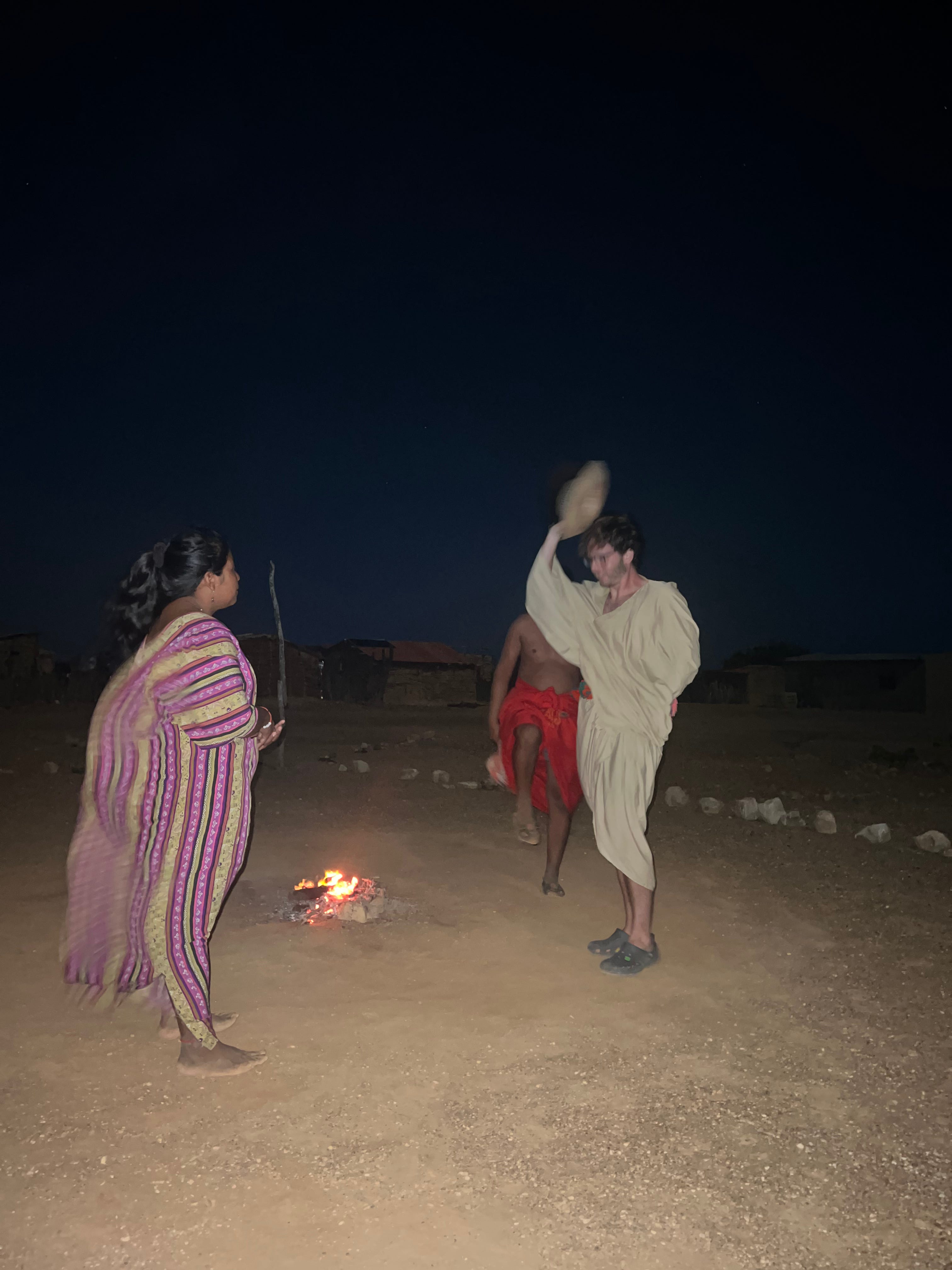
The man is always supposed to dance backwards, otherwise he’ll make a bad husband.
We aren’t the only guests at the ranchería that night. A group of middle-aged French tourists is staying there for a couple of nights to immerse themselves in the culture, and we’d met them in the kitchen helping prepare food earlier. None of them, however, speak any Spanish (let alone Wayuunaiki), so their communication with the clan members is limited to broken phrases and gestures. At dinner, we chat with the family while the other group fills the silence at their side of the table by talking French to each other.
I can’t quite figure out whether to judge them or feel bad for them. I’m just glad not to be them.
Digging into my goat, I ask our hosts if they feel more Wayuu or Colombian, and the response is unsurprising—their indigenous identity comes above all else. The Guajira desert spans Colombia and Venezuela, splitting the Wayuu homeland across a border they never chose. It used to be possible to move freely between the two countries before Venezuela descended into a crisis and Colombia had to enforce a stricter border policy. The situation on the border is only one of the factors that caused the formerly quite well-to-do people’s fairly recent plunge into devastating poverty.
La Guajira sometimes ranks as the poorest department in all of Colombia today, despite producing commodities like salt, natural gas or solar energy, and also attracting tourism.
The next day at breakfast, it’s time for our backpacker group to debrief. “I know it’s their culture, so I can’t really say it’s wrong,” Greg the Brit opens the can of worms very carefully, “but the whole locking girls up thing really shocked me.” One of the girls is, however, quick to shut the debate down before it even starts: “Well, I don’t care that it’s their culture. It’s just wrong!” End of discussion. I didn’t weigh in on the topic but left this interaction feeling conflicted, as I thought both were kind of right.
Suddenly, I wasn’t so sure where women’s liberation ends, and Western imperialism begins. Are we, in our stupid amount of European privilege, allowed to tell people that their culture is bad and oppressive? That was only one of the many questions our evening with the Wayuu family left me with.
I’ve always been a bit iffy about visiting indigenous tribes and communities and was never actually seeking this experience out. The ranchería evening was simply a part of our multi-day tour package, so my partner and I figured we’d go and see what happens.
Going into it, I was scared of accidentally participating in some weird human zoo-coded voyeuristic poverty porn. Instead, I spent the time listening to people’s folklore, stories, and learning about th challenges they face out in the desert. I can’t say with certainty it was all 100% ethical. All I know is that it was 100% human, and at the end of the day, I’m glad I did this.
Communities like this ranchería, remote and largely abandoned by the state, are in a constant balancing act of preserving their way of life while being forced to participate in the education system, the labor market, and capitalism in general. For the Wayuu—and many indigenous people worldwide—“performing” culture for tourists serves more than just one purpose. Yes, it’s a source of income. But it’s also a plea for visibility and recognition in a country that still tends to look down on them. It’s asserting their importance in a society that loves to show off the Wayuu bags while overlooking the people who weave them.
The community doesn’t just benefit directly from tourist money and bag sales. Having a relationship with tour operators gives them the option to have food delivered from the city, which is an incredibly valuable asset in such a remote place with no shops or markets nearby. Our car had bags of rice in the trunk, and that was a reason enough for the Wayuu to be happy to see us.
How do they let the tour operator know what they need? WhatsApp, of course, because yes, they do have smartphones, even though with sparse electricity, it can sometimes be tricky to charge them. That doesn’t mean that they have somehow lost their culture or become “too Westernized”. Having access to technology doesn’t make people somehow less indigenous or “authentic”.
I might have become a bit more understanding when it comes to visiting indigenous people, but I still believe it always should come with some level of responsibility, openmindedness, and humility.
If visiting a community or a tribe, ask yourself this:
Are you happy to share space with those people and treat them as equals, or are you there just to stare and take photos?
Are you coming to reinforce your own worldview, or are you willing to listen to someone who likely subscribes to a completely different set of values?
Are you expecting a blast from the past, or are you willing to engage with people where they are right now, even if that means that they might ask you to follow their Tiktok accounts?
And are you able to refrain from passing judgment, even if what you learn and witness shocks you?
If you’re ever in Colombia, I highly recommend giving this overlooked region a chance. Don’t attempt without a reputable tour. We booked through Pura Guajira and I have nothing but great things to say about them.
If you’re interested in Colombia and Latin America, try reading this next →


Thanks for reading! If you enjoyed reading this post, here are a few things you can do to support me & my work. Give the post a like ❤️ , share ↪️ it with a friend or on your social media, or buy me a matcha 🍵 to keep the newsletter going.
You can also become a paid subscriber and have access to the full range of unpacked content.
Appreciate your support xx
Very interesting read! I think this is my favourite thing you said: “I can’t say with certainty it was all 100% ethical. All I know is that it was 100% human.” 👌
Wow, what an interesting experience. I understand how you felt and am curious about how I would behave in such a situation. A couple of years ago I visited the Smoky Mountains national park in the US, and they had a section where you could interact with Native American craftsmen and buy some of their work. I don't remember any complicated feelings about that brief experience, only the fact that they seemed very friendly and relaxed. But I was also very young then and didn't have my current worldview. So much of our perception is shaped by age and experience, it's crazy